Showing posts with label wedding at Cana. Show all posts

Wednesday, December 29, 2021

Wedding sermon for Tanya and Deepak's wedding


Tanya and Deepak's wedding sermon Sermon for Tanya and Deepak's wedding - YouTube
Above is the youtube link of the sermon for Tanya and Deepak's wedding conducted on December 27, 2021 at the Marth Mariam Church (Valiya Palli), Kothamangalam.
The three points of the sermon are
1. The tune/music of marriage.
2. Timing in marriage.
3. Jesus as a model for relationships/marriage.

Sunday, February 15, 2015

Love can perform wonders


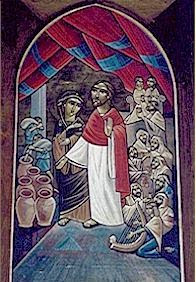
Tonight the Jacobite Syrian Orthodox church embarks on a fifty day lent going through various aspects of human frailty while looking to God in the hope that God will never forsake us.The bible reading for today's Eucharist service St. John 2:1-11 invites us into Jesus' first miracle initiated by his own mother. But aren't we usually missing the point of the miracle when we look at other aspects of the miracle even when one aspect stands out?

1. Love should be above everything- Jesus and his capability of loving everything around him was fabulous. Instead of going along with the societal notion that money flies even above the eagle, Jesus shows that love flies above everything else. Jesus’ love for God’s creation and the mutual love of Jesus with the two blessed forms of the trinity expresses his love for the creation of God. Even when the wine runs out and there is a panic which also makes the mother reach out to her son, Jesus shows what love can do.

The people who were asked to wait upon Jesus are told to fill the stone jars with water. They know what they filled and so does Jesus. But Jesus loves the water and it leads to the transformation of the water. How far can we transform others towards the benefit of all, with our love? Will we remain stone jars or will we offer ourselves for transformation with the love Jesus offers us?

2. Love defines our relationships- We are given a chance to love others through a network created for us through God. We have our family and several members of our family, friends and acquaintances to love and show love to. Jesus had declined Mother Mary’s offer to help the house of celebration. But the plea of Mother Mary was not an ordinary plea but a plea covered with love. This was the love for her son. When she asks her son to help the hosts, she transfers her love for family to new heights. Jesus feels this love and even though he clarifies that his time is not up, he finally performs a miracle. It is a miracle initiated by love.

Jesus uses the stone jars to show this aspect of love. The stone jars filled with water were used for purification but were used for outward purification. The stone like feeling one had remained with outside purification. So Jesus uses the stone jar to show that the love of his mother towards him and his love towards humanity can change the stoniness of the jar and transform that into something life giving and something which can bring happiness.

Even as Valentine’s day brought about the usual commercial activity and hue and cry about erosion of cultural values the story of Fr. Valentine and his commitment towards couples in love and his love towards them takes us to the path of love. Even when the emperor asked the men in the kingdom to forgo marriage for the sake of war, Fr. Valentine supported true love and brought people together in true love. Love is above and beyond everything and love indeed defines our relationships.
This lent, can we evaluate our lives and truly say that we love God and love God’s creation and the network of family, friends, acquaintances and church that God has given us? Or are we still stone jars filled with water that refuse to transform, all the while claiming to offer purity to others? Amen.


(Excerpts from a sermon preached in St. Ignatius JSO Church, K.R.Puram, Bangalore.)
Picture courtesy www.stmarystlouis.bizland.com

Monday, February 20, 2012

The beginning of lent

The beginning of lent in the Jacobite Syriac Orthodox Church starts with the Shubkono service which calls for being at peace with those who we are in contact with. The service is indeed of great significance and the holding of hands and offering peace to everyone brings in a serenity in the midst of the all the affliction we may be experiencing. The specialty of the service is in the reconciliation we seek with our brothers and sisters and those who assemble in church. One can obviously take this a step further by doing the same to people in the work place, school and college. The humility which this brings can obviously bring about much healing not just to the person who reconciles but also to the person who is reconciled with. The inherent meaning at the symbolism of kneeling and asking God for mercy also prepares us to humble ourselves.

Many divisions and problems can be done away with this act of reconciliation. It is important to know that reconciliation makes more sense when it is done from a position of strength. When one looks around one cannot ignore the fact that we are advised never to give up our position of advantage when we are trying to come to a peaceful agreement with someone. Countries and communities will therefore find it difficult to come to terms with a peaceful settlement by giving something away. The true spirit of lent though calls for this giving up of our strength and positions. Lent being a sacrifice also makes sense more to those who have something to sacrifice in the first place. One should be sensitive in not preaching to others to observe lent while continuing in one’s strength and using that to preach down to others.

This sacrifice leads to a strengthening in terms of one’s spirituality. This cannot be gauged in terms of the usual world we live in where strength means beating others into submission. The story of the wedding at Cana is also a sacrifice committed by Jesus for others. This is a sacrifice which takes into consideration the need of others and looks at what we can do for them. Such sacrifice of blood and sweat makes the wine taste better and stronger. Strength is given off by Jesus for the sake of others. It is a strength he possesses but is willing to give away.

The importance of working together during lent also attains importance through the story where St.Mary, Jesus and the workers all together work to strengthening the guests. Such is the strength of community lent as well. It should not matter that we are doing it personally but should rather matter that we are doing is as a team and working towards the accomplishment of a single goal. This will bring about a draining of one’s strength for the replenishing of energy and strength of another. This noble thought of being weak so that someone may become strong rings through the song Amazing Grace with the words “I once was lost but now am found, was blind but now I see.” For the one who is being reconciled with, the thought of a caring being and the possibility to find oneself and be able to ‘really see’ is liberating.

Every lent becomes a time to re-invent what we have done. The basics are always the same but the interpretations have to change so that as we grow, lent also makes more and more sense to us. This is indeed an inspiring thought. We are becoming part of a movement. This is a movement to make the poor rich and the weak strong. For this we have to lent(d) ourselves and feel the energy and inspiration that Jesus’ disciples felt when he asked them to join the movement that he put forward. May reconciliation lead to the washing away of our sins and gaining of the lives of those who lost it for us.

Monday, September 6, 2010

St. Mary the teacher

In Christian theology Jesus comes through as the teacher who answers and guides those who question him. This irrepressible quench for teaching starts at a young age and many are amazed by what the carpenter’s son accomplishes. Even as Mary and Joseph shared this sense of amazement one has to also acknowledge the role they would have played in the development of Jesus.

One can question this quest to identify Jesus’ teachers as a futile attempt that will lead nowhere. How can anyone teach God? Jesus being the child of God would then have known everything and what would then be the reason for anyone teaching him, leave alone Mary and Joseph? But isn’t keeping quiet when needed and non-teaching also a form of teaching? In this regard we can look at St. Mary the teacher.

The wedding at Cana initiates one of the few lines credited to Mary which the biblical writers finally manage to part with. Mary says in John 2:3, “They have no more wine.” Even though this looks like a lecture about the state of wine in that house, it is a question directed at Jesus by Mary in teacher’s robes. The answer is something like Jesus is not ready to answer the question. Unlike many teachers in our time who would then proceed to beat out the answer of the student, Mary tells the others, “do whatever he tells you.” The un-complaining teacher gives space to her student to make sense of the question she has put forward.

What happens later is history and well documented in our minds. To look at this passage for teachers’ day brings about a total re-working of the concept of who a teacher is. In the luminosity of the relationship between Mary and Jesus we are still left in the dark because that is indeed what a student-teacher relationship is. It is abstract to the one looking but clear to those involved. The best teachers I have had are the ones who made me think, who left a space for me to be me, who left the jars empty for me to fill up!

For teachers’ day the concept of a teacher has to be re-defined before we wish happy teachers’ day. Who is my teacher? My teacher is the one who allows me to learn and do. For this reason I cannot define who my teachers are. They are one and many. My mother, father, priest, aunt, school facilitator, theology guide, college friend, wayside vendor, co-journeying passenger! Happy teachers’ day to all of you. You have left the jar empty so that I could figure out what to do with it.

Monday, February 15, 2010

Will you be my Valentine this lent?

Yesterday in church I preached about preparing for the great lent. But I also preached on Valentine’s day. Obviously one would immediately resent any relation between the two. I would agree that Valentine’s as it is celebrated now does not have much in common with lent. But before we come to an obvious conclusion, let us look at both separately.

The great lent in the Jacobite Syrian Orthodox church starts after the Sunday worship, with the wedding at Cana as the gospel reading. The lent actual starts after the evening prayer on the same day. We are initiated into the great lent with thoughts from the wedding at Cana, where Jesus turns water into wine to save the wedding attended by his mother Mary and his disciples. The act of Jesus suggests love, trust, mystery and satisfaction. The love for his mother and the love for the people makes Jesus intervene, although he himself says it is not yet his time. His mother Mary despite his disinterest maintains a deep and profound trust in him when she tells the helpers at the wedding to do as he says. What happens then is a total mystery, just as worship or qurbana is a mystery. The ordinary water turns into wine. How this happens is beyond us. Finally the chief steward tastes it and declares that it is so good. He goes on to say that usually the best is given at the beginning but in this case the best is saved for the last. The satisfaction is for those who have waited till the end!

Valentine’s day is a celebration in itself and is especially popular with young people. But the myth or even history about Valentine is quite different from what we see now. Sifting among the various stories, one which is believable is one in which the priest Valentine went against the emperor’s edict that young men should not marry because he wanted them to be in his army. The priest goes against this and encourages couples to get married. Truly by this account, it is a call to a life long commitment!

Valentine’s day now has become some kind of a pressure for girls and boys, men and women. The pressure of going out with someone and being a part of a cultural performance. But I wonder whether this is how it is meant to be. The church is helping to make people understand that love is a more permanent feature and not just some one off thing once a year. This is also why we can connect Valentine’s day and the great lent.

Of course this is not an attempt to impose something on to the younger generation. What they want to do is obviously their own decision. The church or priests like me cannot judge them based on this. But what we can do is to offer our interpretation of Valentine’s day. And at the end of it all, it won’t just be a one sided version of love and love between young couples only, but a more comprehensive definition of love and how this concept can help us. We can use the concept of Valentine’s day to understand, profess and spread love to not just young couples, but to all kinds of people, groups and dispensations. The love which is compassionate, involves trust, is a mystery and gives satisfaction for those who wait patiently.